Latest
February 10, 2026
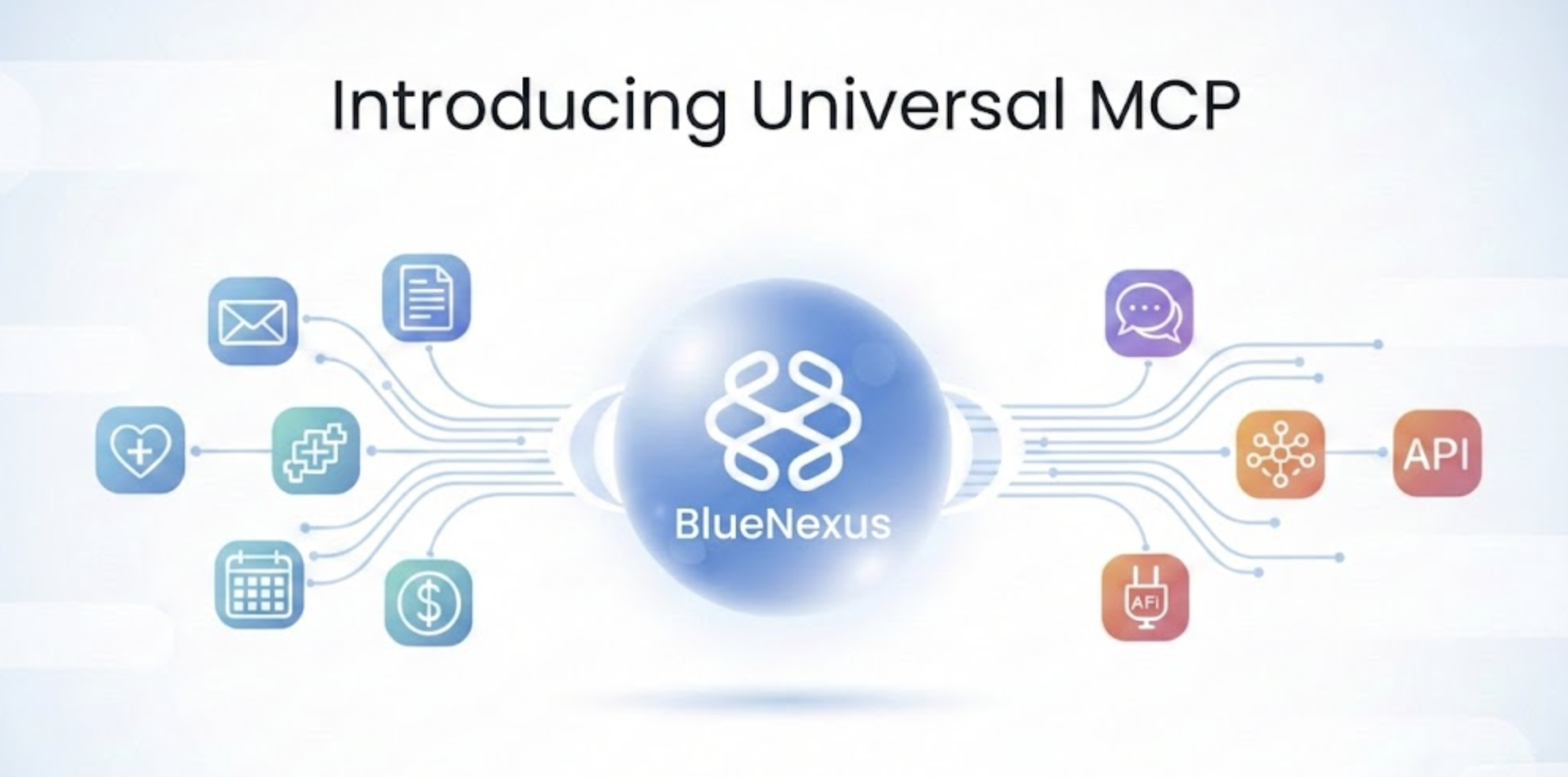
Introducing the Universal MCP Server
The Context Problem in Personal AI
I've been building AI agents for personal productivity, and I kept hitting the same wall: getting my agent to access all my data in a way it could actually understand. The real challenge wasn't just connectivity - it was making that data useful to the AI while keeping it secure.
After wrestling with custom integrations, token management, and context window limitations, I realized we needed a fundamentally different approach. That's why we built the Universal MCP Server - a single endpoint that intelligently manages the bridge between your private data and any AI model.
What is the Universal MCP Server?
The Universal MCP Server is a remote Model Context Protocol (MCP) server that generates the optimal context window for any user prompt. Think of it as an intelligent middleware layer that sits between your data sources and AI applications.
Here's the core workflow:
- Prompt Analysis → The system receives a natural language request
- Source Selection → It identifies which data sources contain relevant information
- Intelligent Retrieval → Pulls data via third party APIs, MCP servers, Databases and more.
- Context Synthesis → Compresses and formats the most relevant information
- Structured Response → Returns optimized JSON or text to the LLM
But here's what makes it different: instead of dumping all available data into the LLM's context window, it acts as a Context Engine that filters and optimizes information before it reaches the model, significantly increasing performance and accuracy.
The Architecture: Two Layers Working Together
The Context Engine (Intelligence Layer)
When you ask something like "What did my team discuss about the Q4 budget?", the Context Engine doesn't just search for keywords. It:
- Locates the Q4 budget document and identifies recent comments
- Searches your company Notion for meeting notes
- Pulls relevant meeting transcripts from AI note taker (ie: Fireflies)
- Compiles all this data into a coherent narrative
This isn't simple aggregation - it's intelligent context formation. The engine understands relationships between different data types and prioritizes information based on relevance to your specific query.
The Universal Bridge (Connectivity Layer)
The second layer provides universal compatibility across AI platforms. Using the Model Context Protocol, it creates a single bridge connecting your private data to ChatGPT, Claude, Gemini, your own agents or applications. Basically you can connect to any MCP-supporting applications or code.
BlueNexus supports dynamic OAuth connectivity, so in many instances you can simply add the BlueNexus endpoint to your application:
https://api.bluenexus.ai/mcp
For some older clients, you will need to manually configure with a BlueNexus personal access token:
- Create a BlueNexus account
- Obtain your unique personal access token via the BlueNexus dashboard
- Use our one-line connection scripts to sync with any AI application
Why Current MCP Implementations Fall Short
Working with MCP servers extensively, I've identified three critical issues:
1. Tool Proliferation
MCP servers expose lists of tools that consume valuable context window space. Connect too many servers, and you've got hundreds of tools cluttering the LLM's context, making it harder for the model to understand what to call.
2. Context Generation Cost
Here's a fundamental truth about AI: what fuel is to cars, tokens are to AI. Every token consumed costs money and compute power. Current MCP implementations are economically suboptimal because they waste context window space on tool definitions rather than actual work.
You wouldn't drive your car to five different locations looking for the right wedding suit - you'd research and map out your purchase decision before getting in the car. Similarly, we shouldn't be loading hundreds of tools into an LLM's context window just to find the right one. For businesses watching API costs and eco-conscious developers concerned about compute power, this inefficiency is unacceptable.
2. Single-Tenant Inefficiency
Most MCP servers (excluding remote MCP servers) run on a per-user basis, which is incredibly inefficient, requiring a MCP server per user. We need multi-tenant servers that can support multiple users while still protecting individual tokens and data in a highly secure environment.
3. Credential Complexity
The current credential management nightmare is holding back AI adoption. Users face:
- Zero reusability - You connect your Google account to ChatGPT, then do it again for Claude, then again for your custom agent
- Repetitive authentication - The same OAuth dance, over and over, for every new AI app you try
- Developer overhead - Many MCP servers require you to register your own application, manage API keys, and handle OAuth flows yourself
This isn't just inconvenient - it's a fundamental barrier to AI becoming truly personal. Although dynamic client registration in the MCP spec will help, it doesn't solve the core problem of fragmented credential management across the AI ecosystem.
Our Solution: Unified, Secure, Intelligent
The Universal MCP Server addresses each of these problems:
Unified OAuth Management
This is the antidote to credential complexity.
Connect once, use everywhere - that's the promise of BlueNexus.
When you connect your Google account through BlueNexus, that connection becomes available across every MCP-enabled app you want to use. No more repetitive OAuth flows, no more managing dozens of app registrations. Your access tokens are stored in an encrypted database and injected in real-time when accessing third-party services, all within Trusted Execution Environments (TEEs).
Think of it as creating a digital AI brain that you can take with you anywhere. You don't need to register your own applications or run your own MCP servers - BlueNexus handles all the infrastructure complexity.
This means:
- Connect your accounts once, reuse them infinitely
- No application registration headaches
- No server management overhead
- Instant portability across AI platforms
Intelligent Tool Consolidation
By separating tool-calling logic from the LLM's context, we maximize the space available for actual work.
This is a fundamental optimization that delivers:
- Reduced costs - Fewer tokens means lower API bills
- Increased context capacity - More room for your actual data and conversation history
- Drastically improved performance - LLMs work better when they're not drowning in tool definitions
BlueNexus introduces cost and performance optimizations that a traditional LLM simply can't achieve on its own. Instead of exposing hundreds of individual tools, we provide a single, intelligent interface that routes requests appropriately. The Context Engine determines what's needed and fetches it - no tool spam in your context window.
Multi-Tenant Architecture with Privacy
Our server supports multiple users efficiently while maintaining complete data isolation. Each request carries a BlueNexus access token with user-specific scope, ensuring your data remains yours alone.
The Privacy-First Approach
I've always been passionate about data privacy and security, and I believe protecting user data isn't optional - it's fundamental. That's why we've built privacy into the architecture from day one:
- TEE-Protected Processing: All data handling occurs within Trusted Execution Environments
- Encrypted Token Storage: Access credentials are encrypted at rest and in transit
- Zero Knowledge Architecture: We process your data without storing or viewing it
This isn't just about compliance - it's about giving users confidence that their data isn't being consumed by big tech companies or accessed by others. While local processing is possible for technical users, we want a solution viable for everyone, which means providing confidential compute for AI infrastructure.
Real-World Applications
Health Intelligence
Connect all your wearable data and use AI to analyze your health patterns, provide personalized recommendations, and support your health journey. The Context Engine can pull from multiple sources - fitness trackers, health apps, medical records - to generate meaningful dashboards showing key health information in one place.
Productivity Workflows
The system excels at complex, multi-step tasks that typically fail with standard LLM setups. Meeting scheduling, for example, becomes a seamless four-step optimized process:
- Finding relevant documents
- Extracting participant information
- Checking calendar availability
- Sending invitations
Without the Context Engine, these workflows often fail due to tool-call errors, rate limits, and inability to manage complex logic. With it, they complete reliably and efficiently.
Financial Intelligence
Imagine asking "How much have I spent on electricity this year?" and getting an instant, accurate answer.
BlueNexus searches invoices across Gmail, Google Drive, Documents extracting payment totals, and returns a 12-month breakdown with citations. Or consider tax preparation - the system can aggregate receipts, categorize expenses, and compile documentation from across all your financial platforms.
The versatility of BlueNexus extends to any domain where context matters.
For end users, it means portable onboarding - use every app for the first time like you've used it forever. Your preferences, history, and context travel with you.
For app developers, it means context-rich awareness of your users from day one. Better engagement, better outcomes, and more conversions - because sales is always easier when you truly understand your customer.
The Technical Edge: Intelligent Context Model
Our flexible context model adds a middle layer of agentic capabilities that can analyze user requests and intelligently locate the most relevant data. It's not just about retrieval - it's about:
- Prioritization: Understanding which information matters most for the specific query
- Compression: Removing redundant or irrelevant data
- Formatting: Structuring information in ways LLMs can best utilize
- Relationship Mapping: Understanding connections between disparate data sources
This combination of external data connectivity, RAG systems, hybrid search, vector databases, and user memory provides a unified, powerful intelligence context engine.
Performance Expectations
While we're still gathering comprehensive metrics from production deployments, the architecture is designed to deliver:
- Significant token reduction by sending only relevant, compressed context
- Increased reliability through intelligent routing and error handling
- Faster response times by eliminating unnecessary data processing
- Higher quality results through better context formation
Getting Started
We're currently onboarding early users to the Universal MCP Server. The process is straightforward:
- Sign up for a BlueNexus account
- Connect your data sources through our OAuth flow
- Integrate with your preferred AI platform using our connection scripts
For developers, we provide simple copy-and-paste code snippets for connecting to existing AI agents. For consumers, we offer step-by-step guides for popular platforms like ChatGPT and Claude.
Final Thoughts
The future of personal AI depends on solving the context problem - getting the right information to AI models in the right format at the right time. The Universal MCP Server represents our approach to this challenge: a privacy-first, intelligent bridge between your data and AI capabilities.
By handling the complexity of data access, credential management, and context optimization, we're removing the barriers that prevent AI from becoming truly useful for personal productivity. The goal isn't just to connect AI to your data - it's to make that connection intelligent, secure, and effortless.
The Universal MCP Server is more than infrastructure; it's the foundation for a new generation of AI applications that can actually understand and work with your personal context. And we're just getting started.
Chris Were - BlueNexus Founder & CEO
06/02/2026
Context Is the New Code: Rethinking How We Build AI Agents
November 5, 2025
The BlueNexus team are constantly researching emerging trends within the AI sector. Earlier this week we came across an extremely interesting article which proposed the notion of focusing strongly on context within LLM training methods. We find this particularly interesting as it strongly aligns with our product offering and wider vision of how AI not only should be developed, how it must be developed.
What if the secret to building smarter AI agents wasn’t better models, but rather better memory & context? This is the core idea behind Yichao Ji’s recent writeup, which details lessons from developing Manus, a production-grade AI system that ditched traditional model training in favour of something far more agile - "context engineering".
From Training to Thinking
Rather than teaching an LLM what to think through intensive fine-tuning, Manus has been focusing on designing how it thinks, via structured, persistent, runtime context.
Key tactics include:
- KV-cache optimization to reduce latency and cost
- External memory layers that store files and tasks without bloating prompts
- Contextual “recitation”, for example agents reminding themselves of their to-do list
- Error preservation as a learning loop
- Tool masking over tool removal, to retain compatibility and stability
This approach points to a deeper shift in the LLM training debate, shifting from “prompt engineering” to context architecture, and it’s changing how intelligent systems are being built.
Diving Deeper
Ji’s article observes that developers still default to the “If the model isn’t good enough, retrain it" approach. But Manus demonstrates that this isn't scalable. It’s expensive, brittle, & hard to maintain across use cases. Instead, they show that by designing the right context window with memory, goals, state, & constraints, developer you can achieve robust agentic behavior 𝐟𝐫𝐨𝐦 𝐞𝐱𝐢𝐬𝐭𝐢𝐧𝐠 𝐋𝐋𝐌𝐬.
We don't necessarily see this as a "work around" but rather the new standard emerging, which is fantastic within the R&D lens of LLM training.
Obligatory mention that we carry some level of bias here, as this new standard plays straight into our wheelhouse.
Alas, BlueNexus Agrees
We wont sit here and "Shill" this approach from the roof tops, it’s fair to say this emerging standard aligns strongly with what we have been building.
The future of AI isn’t just about inference, speed or model accuracy, in our opinion it’s about relevance, continuity, portability and coordination.
By this we mean:
- Knowing what data should (and shouldn’t) be in scope within any given prompt or automation
- Remembering past actions across sessions & various tools / 3rd party applications
- Structuring memory & state for reasoning, not just retrieval
As always, were interested in what other AI builders think?
- Are we overvaluing model complexity & undervaluing memory infrastructure?
- What makes context trustworthy, especially across tools, users, & time?
- Could context-based architectures unlock broader access to AI, without the cost of custom training?
- Is “context as code” the new OS for agents?
We would love to get a collective thoughts across the spectrum from anyone participating in this space. Feel free to add your colour to the conversation & start a dialogue with likeminded people in the comments below.
Breaking the Walled Gardens: The Push for Tech Interoperability
October 28, 2025
Quick one today, as the team focuses on final checks and balances for an upcoming deployment. In this weeks article, we examine old business models coming to an end as new tech muscles its way through the "walled gargens" of big tech, to create a more open and interoperable future.
For years, Big Tech has profited by building "walled gardens", that is - closed platforms that tightly control apps, data, and user experience. These ecosystems, like Apple’s App Store or Meta’s social networks, maximize revenue and lock-in but restrict user freedom and innovation. Today, the tide is turning. Consumers, regulators, and even some companies are now demanding interoperability: seamless connection between apps, platforms, and devices. The result? A major shift in how digital infrastructure is being built.
The Signs of Change
- Cross-Platform Messaging: Apple will adopt RCS, improving messaging between iPhones and Androids. Under EU pressure, Meta is working on interoperable WhatsApp and Messenger platforms. The days of siloed chat apps are numbered.
- Smart Home Unification: Matter, an open smart home protocol supported by Apple, Google, Amazon, and others, now enables devices to work together regardless of brand.
- App Store Alternatives: In response to Europe’s Digital Markets Act (DMA), Apple is allowing third-party app stores and alternative payment systems on iOS—a sea change in how apps are distributed.
- Data Portability: New rules in the EU require platforms to let users move their data between services. Companies like Meta and Google now offer improved tools for exporting content and contacts.
- Open Social Networks: Meta’s Threads plans to integrate with ActivityPub, allowing users to interact across decentralized platforms. Tumblr and Flipboard are doing the same.
Consumer Preference
Interoperability matters to users because it offers:
- Freedom to switch platforms without losing data.
- Convenience of unified experiences across devices.
- Transparency and trust through open standards.
Surveys show over 80% of consumers prefer tech that plays well with others. In areas like smart homes and messaging, users are tired of being forced into one brand's system.
Why Companies Are Opening Up
- Regulation: Laws like the DMA in Europe are forcing change.
- User Expectations: Consumers demand flexibility and integration.
- Strategic Advantage: Interoperability can reduce churn and expand markets.
Even historically closed companies are making adjustments. Apple, for example, is embracing RCS and opening up iOS in Europe.
The Challenges Ahead
Interoperability isn’t without hurdles:
- Security and privacy risks increase when platforms open up.
- Loss of revenue from closed ecosystems (e.g., Apple’s App Store fees).
- Fragmentation if standards aren’t widely adopted or well managed.
The Bigger Picture
This is about more than messaging or app stores. It’s about redefining how digital systems are structured: from isolated silos to connected ecosystems. Users will gain freedom, developers will gain reach, and companies that embrace openness early may gain a competitive edge.
Final Thought
The push for interoperability is more than a trend it’s a structural shift. Platforms that prioritize openness, data portability, and integration are better positioned for the future. For users and builders alike, the walls are coming down—and the digital world is becoming a more open place to build.
The Future of AI Monetization: Are We Headed for an Ad-Supported LLM Economy?
October 21, 2025
Since the inception of the first mainstream retail facing AI (GPT), the dominant business model for AI assistants has been paywalls (Pro tiers) and usage-based APIs. But as inference costs fall, LLM models converge in their abilities and assistants eat more of the consumer attention stack, signs point to a familiar destination: ads.
A Race to the Bottom?
Three forces are converging where LLM’s are concerned.
- Rapid price compression - Analyses from a16z and others show LLM inference costs collapsing at extraordinary rates (10× per year for equivalent performance in some estimates), which pressures providers to cut prices to stay competitive and expand usage footprints. Over time, cheaper inference makes ad-supported models more viable at massive scale.
- Platforms are already testing ads in AI UX. Perplexity began experimenting with ads (including “sponsored questions”), laying out formats that blend with conversational answers. Google now shows Search/Shopping/App ads above or below AI Overviews, and leadership has telegraphed “very good ideas” for Gemini-native ads. That’s a direct bridge from keyword ads to AI answers. Snap and others are rolling out AI-driven ad formats (sponsored Lenses, inbox ads), normalizing AI-mediated, personalized placements.
- The search precedent. Ad-free, subscription search (Neeva) closed its consumer product, an instructive data point about the difficulty of funding broad information services purely with subscriptions.
Put together: the economics and UX rails for advertising inside assistants are falling into place.
But it’s not that simple: 3 strategic counter-currents
A. API revenue isn’t going away. Enterprise APIs remain sticky, and top-tier reasoning models still carry non-trivial costs (driving usage-based pricing and value-based packaging). Even bullish observers note advanced tasks incur higher costs that won’t commoditize as quickly.
B. Regulation & trust are tightening. The FTC is actively targeting deceptive AI advertising and claims, and California’s CPRA expands opt-outs and limits around sensitive data—guardrails that complicate hyper-targeted ads based on AI-enriched profiles.
C. Cookies aren’t (fully) dead, yet. Google’s third-party-cookie phase-out has been delayed and reshaped multiple times, signaling a messy transition from old targeting rails to new ones. That uncertainty slows the clean hand-off to purely AI-native ad targeting.
The likely outcome, a “tri-monetization” model
Expect leading AI platforms to run three parallel models:
- Consumer Free + Ads. Assistants inject sponsored answers, product placements, or commerce links—especially in high-intent categories (travel, shopping, local). This aligns with how Google is already positioning ads around AI Overviews and how Perplexity has tested formats. There are some nuances here which will all come down to delivery and execution.
- Premium Subscriptions. Ad-light or ad-free tiers with priority compute, longer context windows, and premium tools (collaboration, analytics). Even if ads expand, a sizable cohort will pay to reduce ad load and raise limits, similar to the Spotify playbook.
- Enterprise SaaS + Usage-Based APIs. The durable, high-margin layer: SLAs, governance, connectors, private deployment options, and compliance guarantees. This remains where buyers pay for certainty (and where ad models don’t fit).
The interesting notion about this prospective shift in revenue models is how the wider retail market will react.
Consumers have become so accustomed to the “Data Stockholm model” - the long-standing trade of free software for personal data — that it has evolved into a kind of digital cultural norm. For decades, people have accepted the idea that access to “free” platforms comes at the hidden cost of surveillance, profiling, and monetization of their digital selves.
That uneasy equilibrium mostly held when the algorithms behind those systems were static and predictable. But as AI becomes the interface for nearly every digital interaction, the equation changes. The idea of handing over your personal data not to a dumb algorithm, but to a self-learning system capable of generating, inferring, and acting on that data introduces an new layer of discomfort.
Public trust in big tech is already fraying. Recent surveys show a majority of users are uneasy about companies using personal data to train generative models. This raises a crucial question:
Are consumers ready to pay for AI services in exchange for real privacy and data autonomy?
Or will they continue to tolerate the invisible bargain - accepting “free” AI assistants that quietly harvest behavioural data to fuel model training and hyper-personalized advertising?
While many retail users may not fully grasp the nuanced implications of AI-driven data use, the notion of data sovereignty - owning and controlling your own digital footprint, is beginning to resonate. It may well become the catalyst for a cultural shift: away from “free for data” toward paid trust.
If that shift happens, it won’t just redefine how AI is monetized; it will redefine how digital trust itself is valued.
Hyper-personalized ads: the promise and the peril
Should retail choose to continue with the status quo, lets examine how that may look. Firstly, why would such large players such as open AI & Anthropic even consider adding advertising to the mix, thats an instant turn off, right ? The issue isn’t necessarily wether this is an intentional choice, but rather a financially strategic play. For example while OpenAI boast am impressive MAU of 800 Million users (just under 1/4 of the global populace), only 5% of those users are paying users. When we couple this figure in with the fact that OpenAI carried a 5 billion dollar loss in 2024 (forecasted to be as high as 14 billion by 2026), it is clear that there is going to be an uphill battle to condition consumer behaviour away from the “free for data” mindset & towards a more traditional monetary exchange model.
This notion is amplified, when we question what LLM’s will look like in the next decade. Some argue that this is a virtual “race to the bottom”, where by LLM models will eventually offer little distinction from one and other, thus, the battler for market share wont come down to product, but price. As this “digital Mexican stand off” takes effect, it will all come down to who blinks first. When one constructs these three factors into a logical argument for business strategy, its not too far fetched to conclude that most LLM’s will end up generating a vast majority of their revenue, from advertising, carefully curates and served up courtsey of the data that users are feeding their preferred LLM model.
If this becomes a norm, is it really all that bad? Lets quickly examine the pros and cons.
Pros. AI’s ability to model real-time context could make ads more useful: for example, an assistant that (with consent) knows your itinerary, food allergies, and budget to surface the right restaurant with instant booking. WPP’s recent $400m partnership with Google is a great example of how agencies are betting on AI-scaled personalisation and creative generation.
Cons. Hyper-personalization relies on first-party data and sensitive signals. While there are regulatory and legislative limits in place for the use of sensitive personal information, these protections are geographically skewed and have alot of catching up to do. Until such guardrails are put in place, the protection of how your data is used, primarily comes down to individual product “terms of use” - When was the last time you read one of those?
Its the Users Choice, but Chose Carefully
If hyper-personalized ads are inevitable in some AI contexts, they must be consented, sovereign, and provable. Architectures that keep user data in controlled environments, attach revocable consent to every data field, and log every use give enterprises a way to experiment with monetization without corroding trust. That’s where privacy-preserving data vaults, confidential compute, and auditable policy enforcement become not just “nice to have,” but the business enabler.
Question for readers: If assistants start funding themselves with ads, what standards (disclosure, consent, data boundaries) should be mandatory before you’d allow them to personalize offers for your customers or you as a retail user?

Beyond the Token Limitations: Why AI Agents Need Smarter Context Pipelines
September 15, 2025
Have you ever come across that annoying message while using your favourite LLM: "Context window limit reached"? Then the model prompts you to open a new chat, and you realise all the content, context, and memory from your previous conversation is gone?
Welcome to the world of context windows.
In this week’s thought leadership article, we explore what context windows are and unpack the nuances that come with them.
Backdrop
Every LLM from GPT-4 to Claude and everything in between operates within a fixed limit of memory (tokens). Every message, tool, file, or instruction sent to the LLM counts against that limit. The bigger the stack of tools, the less room there is to think. Think of this fixed memory limit as a budget you have for any given interaction with an LLM. Once that budget runs out you need to open up a new “account” (chat interface) where a fresh budget can begin.
TLDR;
The more "smart" you try to make your agent, the less room it has to actually be smart.
Take this real-world example from our own internal development tests, within one of our Claude-based development environments. Enabling only two MCP (Model Context Protocol) servers—one for GitHub, one for internal dev context—consumed over 20% of the entire Claude context window.
That’s 1/5th of the model’s "brain" already spoken for… before we even start the task.
Why This Is a Problem for Agentic Systems
While this is an annoyance for basic chat prompt tasks, its not the end of the world. One simply needs to update the new chat with added context to pick up from where one left off in the previous chat that has hit its context window. While this is sparks UX issues, it can be worked around. The main issue is where context windows interfeere with Agentic systems. Why ? Because the benifit behind agentic systems and workflows is their autonomy. The ability to navigate your workflows, recall previous context, act across tabs, tools, and time.
But how can they do that if:
- Each tool adds permanent weight to the context window?
- Each session resets their "memory"?
- Each user identity is siloed across apps?
This is where most agent frameworks hit a wall. They scale horizontally (more integrations, more tools), but not contextually.
The Missing Piece: Whats the Solition?
Rather than proxying tools 1:1 into the LLM, what if we routed them through some kind of a Universal MCP? Think of this notion as a context-aware engine that:
- Compresses tool memory into abstractable formats
- Injects only relevant data on-demand
- Shares memory across agents & sessions
- Binds actions to permissioned identity
Think of it like middleware for agent cognition. Not just smart prompts, but smart context orchestration.
Without it, LLMs will stay stuck in a loop thats powerful in theory, but fragile in production.
What About Sovereignty?
Here’s the kicker: Most bloated context strategies don’t just harm performance, they harm privacy.
If everything is passed raw into the LLM, how do you audit it?
How do you redact or control retention?
How do you enforce per-user or per-org data boundaries?
Adopting a Universal MCP layer could enable sovereignty to become programmable—not just a compliance checkbox, but a default architecture.
BlueNexus Is Betting on This Layer
We believe the future of AI isn’t just about model size or parameter counts. It’s about who controls memory. It’s about how context is stored, retrieved, and reasoned with. It’s about empowering developers and users equally with tools that actually scale intelligence, not just integrate it.
If you’re working on similar problems agent infra, context pipelines, memory routing we’d love to talk.
Let’s fix the foundations before we build the skyscrapers.

Agentic Browsers Are Coming—But Who’s Building the Infrastructure?
September 9, 2025
Have you ever come across that annoying message while using your favourite LLM: "Context window limit reached"? Then the model prompts you to open a new chat, and you realise all the content, context, and memory from your previous conversation is gone?
Welcome to the world of context windows.
In this week’s thought leadership article, we explore what context windows are and unpack the nuances that come with them.
Backdrop
Every LLM from GPT-4 to Claude and everything in between operates within a fixed limit of memory (tokens). Every message, tool, file, or instruction sent to the LLM counts against that limit. The bigger the stack of tools, the less room there is to think. Think of this fixed memory limit as a budget you have for any given interaction with an LLM. Once that budget runs out you need to open up a new “account” (chat interface) where a fresh budget can begin.
TLDR;
The more "smart" you try to make your agent, the less room it has to actually be smart.
Take this real-world example from our own internal development tests, within one of our Claude-based development environments. Enabling only two MCP (Model Context Protocol) servers—one for GitHub, one for internal dev context—consumed over 20% of the entire Claude context window.
That’s 1/5th of the model’s "brain" already spoken for… before we even start the task.
Why This Is a Problem for Agentic Systems
While this is an annoyance for basic chat prompt tasks, its not the end of the world. One simply needs to update the new chat with added context to pick up from where one left off in the previous chat that has hit its context window. While this is sparks UX issues, it can be worked around. The main issue is where context windows interfeere with Agentic systems. Why ? Because the benifit behind agentic systems and workflows is their autonomy. The ability to navigate your workflows, recall previous context, act across tabs, tools, and time.
But how can they do that if:
- Each tool adds permanent weight to the context window?
- Each session resets their "memory"?
- Each user identity is siloed across apps?
This is where most agent frameworks hit a wall. They scale horizontally (more integrations, more tools), but not contextually.
The Missing Piece: Whats the Solition?
Rather than proxying tools 1:1 into the LLM, what if we routed them through some kind of a Universal MCP? Think of this notion as a context-aware engine that:
- Compresses tool memory into abstractable formats
- Injects only relevant data on-demand
- Shares memory across agents & sessions
- Binds actions to permissioned identity
Think of it like middleware for agent cognition. Not just smart prompts, but smart context orchestration.
Without it, LLMs will stay stuck in a loop thats powerful in theory, but fragile in production.
What About Sovereignty?
Here’s the kicker: Most bloated context strategies don’t just harm performance, they harm privacy.
If everything is passed raw into the LLM, how do you audit it?
How do you redact or control retention?
How do you enforce per-user or per-org data boundaries?
Adopting a Universal MCP layer could enable sovereignty to become programmable—not just a compliance checkbox, but a default architecture.
BlueNexus Is Betting on This Layer
We believe the future of AI isn’t just about model size or parameter counts. It’s about who controls memory. It’s about how context is stored, retrieved, and reasoned with. It’s about empowering developers and users equally with tools that actually scale intelligence, not just integrate it.
If you’re working on similar problems agent infra, context pipelines, memory routing we’d love to talk.
Let’s fix the foundations before we build the skyscrapers.

Content Credentials: A Turning Point for Trust in the Digital Wild West
August 25, 2025
The Line Between Reality and Artificiality Gets Thinner Every Day.
Deepfakes. Synthetic media. AI-generated content. These aren’t fringe experiments anymore, they’re now embedded in the workflows of creators, brands, bad actors, and everyday users. And with them comes an urgent challenge: trust is eroding.
We find ourselves living in a world where digital content drives decisions, policy, and public sentiment, as such, provenance has become more than a technical curiosity, it’s rapidly becoming a cornerstone of digital credibility.
Enter C2PA.
What Is C2PA?
The Coalition for Content Provenance and Authenticity (C2PA) is a cross-industry initiative led by Adobe, Microsoft, Intel, and now Google. The mission? Create a standardised, interoperable way to attach metadata to digital content including who created it, when, where, and how it was altered.
Recently, Google announced that its Pixel devices will begin embedding C2PA Content Credentials into its pixel generated images, making it possible to verify authenticity directly at the source.
This signal from Google depicts that content authenticity is becoming a baseline expectation among consumers, not a just a "nice-to-have".
Impacts
1. Transparency by Default
With C2PA, creators and consumers gain visibility into the full “origin story” of content:
- What device captured it
- What edits were made
- Who made them
This isn’t just about stopping bad actors, it’s about empowering creators to protect their work and users to verify what they’re seeing.
But to work at scale, this must go beyond metadata. It needs to connect with infrastructure that retains memory and context as content moves through platforms, tools, and services.
2. Accountability for AI
With generative AI becoming more powerful and realistic, consumers of digital content need ways to identify AI-generated content at the point of creation, not through platform moderation, which is error-prone and reactive.
Embedding content credentials at the source helps maintain a trust layer in workflows that might include:
- Multi-agent collaboration
- AI-generated visuals and documents
- Real-time automation
The future may include agentic workflows where metadata triggers compliance checks, flags anomalies, and restricts distribution based on defined rules, all within confidential compute environments like TEEs.
3. Truth in the Public Sphere
We’ve seen it time and again: viral misinformation shapes narratives in politics, conflict, and social movements.
C2PA offers a potential line of defense, a "technological counterweight" of sorts to fight manipulation attempts via content.
Combined with middleware that enables secure, cross-platform verification, it could give journalists, fact-checkers, and watchdogs a way to automatically cross-reference content against trusted archives, without compromising user privacy.
4. Creative Integrity
Artists, photographers, and brands currently face unprecedented risks from plagiarism and unauthorised reuse.
Provenance metadata offers more than protection, it’s a framework for sovereignty of digital content.
When connected with universal connectors inside creative platforms, content credentials could evolve into the UX layer for a new era of digital rights management, verifiable, portable, and creator-controlled.
Challenges
Interoperability
If provenance tools are siloed by vendor or platform, bad actors will just exploit the gaps. For C2PA to truly work, it must be supported by open, interoperable infrastructure so that metadata survives across formats, apps, and ecosystems.
Privacy
Embedding metadata raises valid concerns:
- What if location or identity info is unintentionally exposed?
- How do we balance transparency with user control?
Solutions may lie in tokenized access controls and fine-grained permissions so provenance can flow without leaking unnecessary PII (Personally Identifiable Information).
Trusting the Standard Itself
Even with credentials, there’s a bigger question: Can we trust the issuers of those credentials & furthermore the structure of the standard that governs these credentials ?
Its not surprise that the world is polarised, divided & becoming increasingly more susceptible to manipulation. This highlights the need for independent, verifiable layers based on zero-trust architecture to ensure that the standards themselves don’t become instruments of bias or misinformation.
A Step in the Right Direction
Google embedding C2PA by default within the rollout of new devices is more than a feature release, it signifies that the AI and content industries are hitting a point of inflection.
Just like HTTPS became the standard for secure browsing, provenance could become the norm for content verification.
While we won’t eliminate manipulation entirely, this raises the bar for transparency and tilts power back toward authenticity.
Final Thoughts
With the rapid evolution of AI, not only from a tooling perspective but how we are using it to create, develop & consume, digital trust is a hot topic currently.
As agents, LLMs, and content creation tools proliferate, there is a need to rebuild credibility from the ground up. That starts with verifiable memory, transparent context, and secure data flows.
Content credentials may not solve every problem but they lay the foundation for how humanity might traverse the nuances that emerge from the technical revolution happening before us.
The companies embracing this early aren’t just doing the right thing. They’re architecting a future where trust is programmable.
What do you think?
- Will provenance metadata become the new norm?
- Can it scale without compromising privacy?
- How should platforms balance trust, verification, and decentralization?
Share your thoughts with us below.