
We're already half way through the decade and AI is literally everywhere, but the most pertinent debates happening within the AI space aren’t just about bigger models or clever apps, they’re about trust. Recent headlines range from California passing its first AI safety law to privacy-centric launches like Proton’s encrypted AI assistant. Enterprises, especially in the U.S., have taken notice: as they race to adopt AI, they’re grappling with how to do it responsibly, preserving privacy, complying with regulations, and protecting valuable data. In one striking example, consulting giant Deloitte had to refund a government client after delivering a report riddled with “AI-generated hallucinations,” demonstrating the perils of unchecked AI use in business. Incidents like this highlight a new reality, that, for AI to truly succeed in the enterprise, it must be reinforced, not only robust privacy, but security & trust infrastructure.
The Push for Privacy-Preserving AI in Enterprise
Enterprise leaders are enthusiastic about AI’s potential – yet many remain cautious. Internal data, from trade secrets to customer information, is a crown jewel that must be guarded. Large language models (LLMs) and AI assistants often require loads of data, but giving a third-party AI access to sensitive information can feel like handing the keys to the kingdom. As TechCrunch observed, “most organizations are hesitant to adopt [AI] yet, harboring a pressing concern: data security” – they fear proprietary data “could inadvertently be compromised, or used to train foundation models” without secure infrastructure in place. Early missteps in the industry gave credence to these fears: stories of employees unwittingly feeding confidential info into public chatbots made headlines causing angst within boardrooms.
To bridge this trust gap, AI providers have rushed out enterprise-grade solutions. OpenAI, for instance, launched ChatGPT Enterprise with guarantees that customer data won’t be used for training and is encrypted at rest and in transit. Other AI firms are taking it a step further. Cohere, a Canadian AI company, recently debuted a platform called “North” that lets organizations deploy powerful AI agents entirely within their own environments. In practice, Cohere’s North can even run on a company’s on-premises servers or isolated cloud, so it never sees or interacts with a customer’s data outside the business’s control. The message is clear: to unlock AI’s value, enterprises demand solutions that bring the AI to the data, rather than sending data out into the wild.
This trend extends to big tech and startups alike. IBM and Anthropic announced a strategic partnership to deliver “trustworthy AI” for businesses, and even historically consumer-focused AI players are pivoting to enterprise. The reason is obvious as one analyst put it, enterprise AI might not seem as “sexy” as viral consumer apps, but “it’s actually where the real money is”. Organizations are willing to invest in AI – but only if they can do so safely. That means privacy-preserving AI has evolved from a niche idea to a mainstream requirement. Companies that address it head-on are winning deals, while those that don’t risk being left on the shelf.
Data Sovereignty Becomes Non-Negotiable
Another major factor in 2025’s AI landscape is data sovereignty – where data is stored and processed, and under which jurisdiction’s laws. AI may be borderless in theory, but in practice, where your AI lives can determine whether it’s trusted or even legal to use. Around the world, governments are placing sovereignty at the heart of their digital strategies. The EU’s ambitious GAIA-X initiative, for example, aims to foster homegrown cloud and AI services to ensure European data stays under European rules. India has also imposed strict data localization laws so that sensitive data “remains within its borders”, reflecting a global consensus that control over data infrastructure is a matter of national strategy. In other words, cloud sovereignty isn’t just a buzzword, it’s becoming a baseline expectation & possibly even a regulatory standard in many regions.
What does this mean for enterprises? If you operate globally, you can no longer take a one-size-fits-all approach to AI deployment. Firms are now architecting hybrid and “sovereign cloud” setups that satisfy local requirements while still leveraging global AI innovations. It’s a tricky balance: as IBM’s 2025 CEO Study notes, 61% of CEOs are actively implementing AI solutions while wrestling with sovereignty challenges. These leaders increasingly view data privacy, IP protection, and algorithmic transparency as foundational to scaling AI in a responsible way. In fact, digital sovereignty has shifted from a mere compliance issue to a core strategic priority.
One high-profile example comes from Proton, the Swiss company known for its encrypted email service. Proton recently launched Lumo, a privacy-first AI assistant, and made sovereignty a selling point. Proton’s Lumo AI assistant comes with a friendly cat mascot – and a serious commitment to privacy. Proton designed Lumo to keep no chat logs and to use end-to-end encryption so that even Proton can’t read your communications. Under the hood, Lumo runs on open-source LLMs hosted in Proton’s European data centers, entirely under Swiss and EU privacy. As the company proudly puts it, your queries “are never sent to any third parties,”. By emphasizing its European base and eschewing U.S. or Chinese cloud providers, Proton is tapping into a demand for AI that respects national and regional privacy norms. U.S. enterprises doing business in Europe are taking note – if your AI solution can’t prove compliance with EU data sovereignty standards, don’t expect Europeans (or privacy-conscious Americans, for that matter) to embrace it.
The extract form all of this? Data sovereignty is now a design requirement for enterprise AI systems. Forward-looking organizations are proactively choosing architectures that keep sensitive data in-region and under strict access controls. As one data center CEO put it, sovereignty isn’t something you can “retrofit” later – if you ignore it now, you may face costly migrations when laws tighten up. In contrast, by building with sovereignty and compliance in mind from the start, companies can avoid disruptions and engender trust across global markets.
Navigating AI Regulations
Hand-in-hand with sovereignty concerns is the growing thicket of AI-related regulations. In 2025, lawmakers and regulators have woken up to AI’s impact, and they’re writing rules to rein it in (or at least guide its use). For enterprises, keeping ahead of these rules is becoming as critical as the tech itself.
Perhaps the most influential is Europe’s AI Act, slated to start taking effect in 2025. This sweeping law applies a risk-based approach: “high-risk” AI systems (think healthcare, Finance, or transport AIs) will face strict requirements for data governance, documentation, transparency, and human oversight, while even general-purpose AI models must meet new transparency and safety obligations. Companies deploying AI in the EU will need to maintain detailed “documentation packs, dataset registers, and human oversight procedures” to stay compliant. It’s a lot to prepare for – and the clock is ticking.
In the United States, there’s no single federal AI law yet, but action is bubbling up from all sides. The Federal Trade Commission has warned it will punish unfair or deceptive AI practices, and it updated its Health Breach Notification Rule to explicitly cover many health apps using AI (even if they aren’t traditional HIPAA-covered entities). That means if your fitness or wellness app’s AI mishandles sensitive health data, you could face penalties, even if you thought HIPAA didn’t apply. Meanwhile, state governments are filling the federal void with their own laws. Multiple comprehensive state privacy laws kicked in this year (from California to Virginia), some with provisions targeting automated decision-making and profiling. Even niche areas are getting attention, for example California’s new law regulating AI-driven chatbots (aimed at protecting children and others from harmful “AI companions”) is one early example of targeted legislation.
For enterprises, this patchwork means compliance is no longer optional, it’s mandatory and multilayered. Global companies must juggle EU requirements, U.S. state laws, sector-specific rules (like the FDA eyeing AI in medical devices or the CFPB watching AI in finance), and perhaps soon, an overarching U.S. AI framework. It’s a daunting task. However, there’s a silver lining: a convergence is happening around AI governance standards. International bodies and industry groups are publishing guidelines to help organizations align with best practices. For instance, ISO has introduced a draft ISO 42001 standard for AI management systems (complementing the trusty ISO 27001 for information security), and the U.S. NIST has rolled out an AI Risk Management Framework along with profiles specifically for generative AI. These frameworks give companies a common language to demonstrate accountability. In practice, savvy enterprises are already mapping their AI controls to these standards to “audit-proof” their operations and reassure customers. A recent industry analysis noted that many enterprise buyers now ask detailed questions about how AI vendors handle privacy, such as; do they tag data by its allowed purpose? Are they filtering sensitive info? Can they ensure data stays in-region? Vendors that can answer yes, and here’s the evidence are speeding through security reviews, while those that can’t are seeing deals stall. In 2025, demonstrating compliance isn’t just about avoiding fines, it’s become a key factor in closing business opportunities.
Securing the AI Pipeline – From Data Vaults to Guardrails
Technology is rising to meet these challenges. Just as firewalls and encryption became standard in the era where internet security was of high importance, new tools are emerging as key support towards AI trust infrastructure. Key areas of innovation include; privacy-preserving machine learning, federated learning, encrypted compute, and robust AI monitoring. What ties these together is a simple idea:
AI should not be a black box living outside the enterprise’s control.
Instead, every step of an AI system – from ingesting data, to model inference, to producing outputs – needs safeguards and transparency.
One breakthrough (although not entirely novel) comes from in the realm of confidential computing. This technology uses hardware-based secure enclaves, to run AI models in isolated, encrypted environments. Even if an AI model is processing sensitive text or customer data, it does so in a way that the raw data is never exposed to the outside world – not even to the cloud provider. A leading startup in the confidential compute space, describes the status quo bluntly:
“Traditional AI architectures often fail to provide end-to-end privacy assurance… Data is decrypted for processing, [and] LLMs operate in exposed environments, [with] little visibility – let alone cryptographic proof – of how data is used.”
In other words, today’s typical AI cloud workflow requires a lot of blind trust. Confidential computing challenges that trust notion. With enclaves and related techniques, “no data is exposed until trust is proven," meaning the AI environment must verify its identity and security before it ever sees decrypted data. Everything from the vector databases feeding the model to the model’s own memory can remain encrypted until inside the enclave. The result? Even insiders or attackers at the infrastructure level can’t peek at the data in use.Crucially, these secure AI platforms also provide auditability, an immutable record proving who accessed what and how. Techniques like tamper-proof logs signed by hardware can show regulators and clients that, for example, an AI system only accessed allowed data fields and nothing more. This kind of evidence is increasingly requested under frameworks like SOC 2, GDPR, and even HIPAA in healthcare. In short, if you can’t prove your AI respected privacy and policy constraints, you might soon be out of luck.
Beyond confidentiality, enterprises are layering on AI guardrails to catch issues like mistakes or misuse. These range from prompt filtering (to prevent certain sensitive data or instructions from ever reaching the model) to output detection (to flag or block content that violates policy, whether it’s disallowed personal data or just plain incorrect). The Deloitte fiasco, where a consulting report included fake quotes and errors from an AI, is a cautionary tale in this respect – “if you’re going to use AI… you have to be responsible for the outputs”. That means instituting review processes, validation steps, or AI “fact-checkers” in any workflow that could impact customers or decisions. Some enterprises are even building AI model committees or using tools to trace an AI’s sources for each answer (a process made easier if you confine AI to your curated data versus the open internet). The goal is to harness AI’s speed and scale, without forfeiting accuracy, privacy, or accountability.
Conclusion: Building Trust is the Lynchpin for Securing Enterprise AI Opportunities
The common denominator among all these emerging AI trends, is trust. 2025 has shown that if people and organizations don’t trust an AI system, they simply won’t use it, no matter how impressive its capabilities. On the flip side, those who do establish trust are reaping real rewards: more seamless AI adoption, faster innovation, and stronger relationships with customers and regulators.
For enterprises, the message is that building a trusted AI capability is now a competitive differentiator. It’s about enabling the transformative power of AI everywhere in your business, including in areas that were off-limits due to sensitivity. Imagine AI assistants that can confidently handle your financial projections, legal documents, or patient records because you’ve ensured privacy-by-design, compliance, and oversight at every step. That’s the vision many are working toward: AI that is powerful and principled.
At BlueNexus, this vision is core to our mission. We believe the future of enterprise AI hinges on trust infrastructure, the secure data pipelines, privacy-preserving models, and compliant workflows that let enterprises & the humans that run them, stay in control of their data and destiny. The exciting part is how many others across the industry are reaching the same conclusion. As we move forward, collaboration will be key. Whether it’s sharing best practices on implementing AI securely, contributing to open standards, or simply having candid conversations about what’s working and what’s not, we all have a role to play in shaping AI that we can truly trust.
Share your thoughts: What is your organization doing to ensure AI is used responsibly and transparently?
We invite you to join the conversation. Let’s swap ideas, challenge each other, and build a future where AI’s benefits can be fully realized without compromising on our values. Feel free to reach out or comment with your thoughts – BlueNexus and our community of AI enthusiasts and professionals would love to hear from you!
On this page
Similar Articles
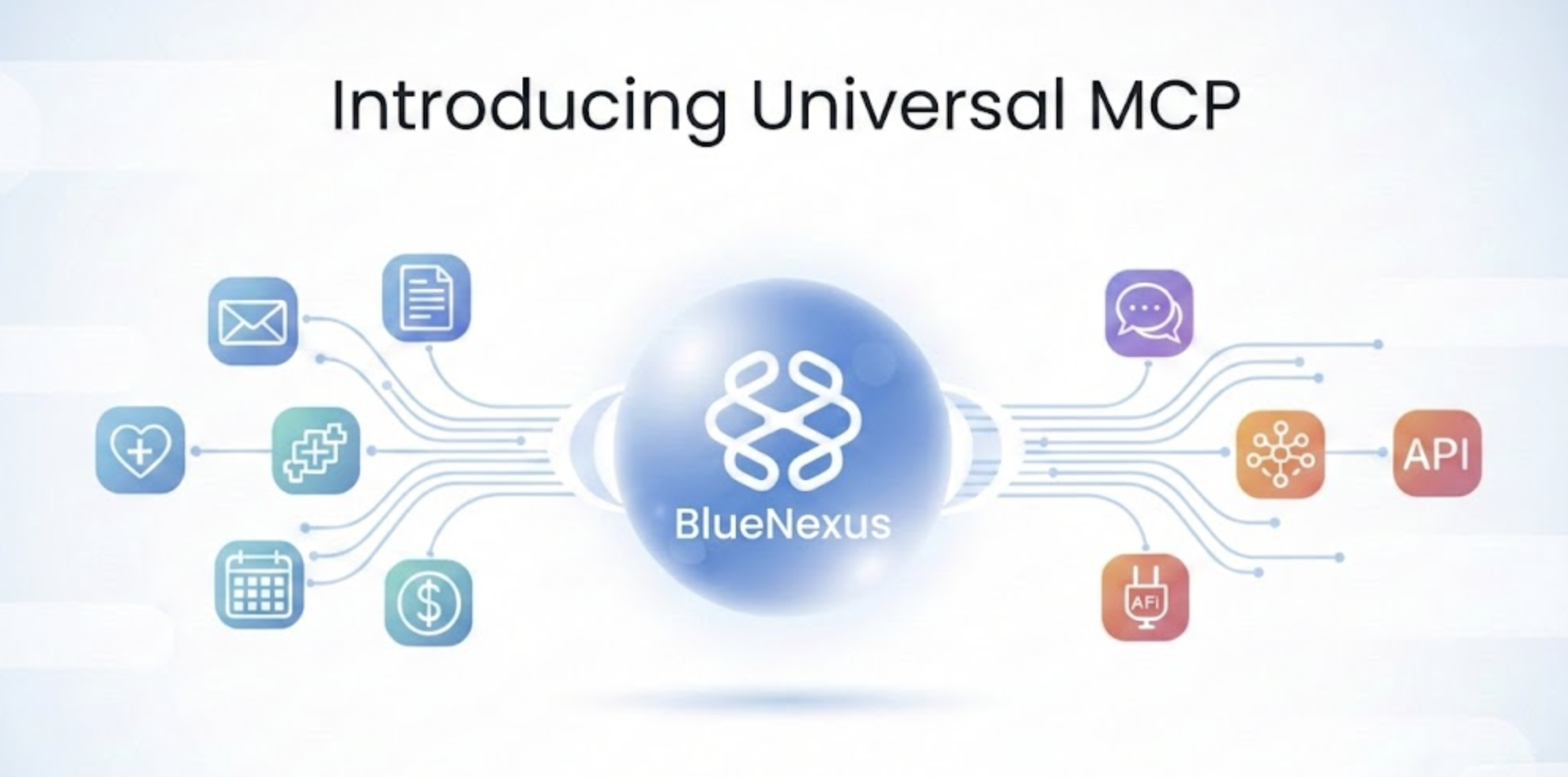
Introducing the Universal MCP Server
February 10, 2026
The Context Problem in Personal AI
I've been building AI agents for personal productivity, and I kept hitting the same wall: getting my agent to access all my data in a way it could actually understand. The real challenge wasn't just connectivity - it was making that data useful to the AI while keeping it secure.
After wrestling with custom integrations, token management, and context window limitations, I realized we needed a fundamentally different approach. That's why we built the Universal MCP Server - a single endpoint that intelligently manages the bridge between your private data and any AI model.
What is the Universal MCP Server?
The Universal MCP Server is a remote Model Context Protocol (MCP) server that generates the optimal context window for any user prompt. Think of it as an intelligent middleware layer that sits between your data sources and AI applications.
Here's the core workflow:
- Prompt Analysis → The system receives a natural language request
- Source Selection → It identifies which data sources contain relevant information
- Intelligent Retrieval → Pulls data via third party APIs, MCP servers, Databases and more.
- Context Synthesis → Compresses and formats the most relevant information
- Structured Response → Returns optimized JSON or text to the LLM
But here's what makes it different: instead of dumping all available data into the LLM's context window, it acts as a Context Engine that filters and optimizes information before it reaches the model, significantly increasing performance and accuracy.
The Architecture: Two Layers Working Together
The Context Engine (Intelligence Layer)
When you ask something like "What did my team discuss about the Q4 budget?", the Context Engine doesn't just search for keywords. It:
- Locates the Q4 budget document and identifies recent comments
- Searches your company Notion for meeting notes
- Pulls relevant meeting transcripts from AI note taker (ie: Fireflies)
- Compiles all this data into a coherent narrative
This isn't simple aggregation - it's intelligent context formation. The engine understands relationships between different data types and prioritizes information based on relevance to your specific query.
The Universal Bridge (Connectivity Layer)
The second layer provides universal compatibility across AI platforms. Using the Model Context Protocol, it creates a single bridge connecting your private data to ChatGPT, Claude, Gemini, your own agents or applications. Basically you can connect to any MCP-supporting applications or code.
BlueNexus supports dynamic OAuth connectivity, so in many instances you can simply add the BlueNexus endpoint to your application:
https://api.bluenexus.ai/mcp
For some older clients, you will need to manually configure with a BlueNexus personal access token:
- Create a BlueNexus account
- Obtain your unique personal access token via the BlueNexus dashboard
- Use our one-line connection scripts to sync with any AI application
Why Current MCP Implementations Fall Short
Working with MCP servers extensively, I've identified three critical issues:
1. Tool Proliferation
MCP servers expose lists of tools that consume valuable context window space. Connect too many servers, and you've got hundreds of tools cluttering the LLM's context, making it harder for the model to understand what to call.
2. Context Generation Cost
Here's a fundamental truth about AI: what fuel is to cars, tokens are to AI. Every token consumed costs money and compute power. Current MCP implementations are economically suboptimal because they waste context window space on tool definitions rather than actual work.
You wouldn't drive your car to five different locations looking for the right wedding suit - you'd research and map out your purchase decision before getting in the car. Similarly, we shouldn't be loading hundreds of tools into an LLM's context window just to find the right one. For businesses watching API costs and eco-conscious developers concerned about compute power, this inefficiency is unacceptable.
2. Single-Tenant Inefficiency
Most MCP servers (excluding remote MCP servers) run on a per-user basis, which is incredibly inefficient, requiring a MCP server per user. We need multi-tenant servers that can support multiple users while still protecting individual tokens and data in a highly secure environment.
3. Credential Complexity
The current credential management nightmare is holding back AI adoption. Users face:
- Zero reusability - You connect your Google account to ChatGPT, then do it again for Claude, then again for your custom agent
- Repetitive authentication - The same OAuth dance, over and over, for every new AI app you try
- Developer overhead - Many MCP servers require you to register your own application, manage API keys, and handle OAuth flows yourself
This isn't just inconvenient - it's a fundamental barrier to AI becoming truly personal. Although dynamic client registration in the MCP spec will help, it doesn't solve the core problem of fragmented credential management across the AI ecosystem.
Our Solution: Unified, Secure, Intelligent
The Universal MCP Server addresses each of these problems:
Unified OAuth Management
This is the antidote to credential complexity.
Connect once, use everywhere - that's the promise of BlueNexus.
When you connect your Google account through BlueNexus, that connection becomes available across every MCP-enabled app you want to use. No more repetitive OAuth flows, no more managing dozens of app registrations. Your access tokens are stored in an encrypted database and injected in real-time when accessing third-party services, all within Trusted Execution Environments (TEEs).
Think of it as creating a digital AI brain that you can take with you anywhere. You don't need to register your own applications or run your own MCP servers - BlueNexus handles all the infrastructure complexity.
This means:
- Connect your accounts once, reuse them infinitely
- No application registration headaches
- No server management overhead
- Instant portability across AI platforms
Intelligent Tool Consolidation
By separating tool-calling logic from the LLM's context, we maximize the space available for actual work.
This is a fundamental optimization that delivers:
- Reduced costs - Fewer tokens means lower API bills
- Increased context capacity - More room for your actual data and conversation history
- Drastically improved performance - LLMs work better when they're not drowning in tool definitions
BlueNexus introduces cost and performance optimizations that a traditional LLM simply can't achieve on its own. Instead of exposing hundreds of individual tools, we provide a single, intelligent interface that routes requests appropriately. The Context Engine determines what's needed and fetches it - no tool spam in your context window.
Multi-Tenant Architecture with Privacy
Our server supports multiple users efficiently while maintaining complete data isolation. Each request carries a BlueNexus access token with user-specific scope, ensuring your data remains yours alone.
The Privacy-First Approach
I've always been passionate about data privacy and security, and I believe protecting user data isn't optional - it's fundamental. That's why we've built privacy into the architecture from day one:
- TEE-Protected Processing: All data handling occurs within Trusted Execution Environments
- Encrypted Token Storage: Access credentials are encrypted at rest and in transit
- Zero Knowledge Architecture: We process your data without storing or viewing it
This isn't just about compliance - it's about giving users confidence that their data isn't being consumed by big tech companies or accessed by others. While local processing is possible for technical users, we want a solution viable for everyone, which means providing confidential compute for AI infrastructure.
Real-World Applications
Health Intelligence
Connect all your wearable data and use AI to analyze your health patterns, provide personalized recommendations, and support your health journey. The Context Engine can pull from multiple sources - fitness trackers, health apps, medical records - to generate meaningful dashboards showing key health information in one place.
Productivity Workflows
The system excels at complex, multi-step tasks that typically fail with standard LLM setups. Meeting scheduling, for example, becomes a seamless four-step optimized process:
- Finding relevant documents
- Extracting participant information
- Checking calendar availability
- Sending invitations
Without the Context Engine, these workflows often fail due to tool-call errors, rate limits, and inability to manage complex logic. With it, they complete reliably and efficiently.
Financial Intelligence
Imagine asking "How much have I spent on electricity this year?" and getting an instant, accurate answer.
BlueNexus searches invoices across Gmail, Google Drive, Documents extracting payment totals, and returns a 12-month breakdown with citations. Or consider tax preparation - the system can aggregate receipts, categorize expenses, and compile documentation from across all your financial platforms.
The versatility of BlueNexus extends to any domain where context matters.
For end users, it means portable onboarding - use every app for the first time like you've used it forever. Your preferences, history, and context travel with you.
For app developers, it means context-rich awareness of your users from day one. Better engagement, better outcomes, and more conversions - because sales is always easier when you truly understand your customer.
The Technical Edge: Intelligent Context Model
Our flexible context model adds a middle layer of agentic capabilities that can analyze user requests and intelligently locate the most relevant data. It's not just about retrieval - it's about:
- Prioritization: Understanding which information matters most for the specific query
- Compression: Removing redundant or irrelevant data
- Formatting: Structuring information in ways LLMs can best utilize
- Relationship Mapping: Understanding connections between disparate data sources
This combination of external data connectivity, RAG systems, hybrid search, vector databases, and user memory provides a unified, powerful intelligence context engine.
Performance Expectations
While we're still gathering comprehensive metrics from production deployments, the architecture is designed to deliver:
- Significant token reduction by sending only relevant, compressed context
- Increased reliability through intelligent routing and error handling
- Faster response times by eliminating unnecessary data processing
- Higher quality results through better context formation
Getting Started
We're currently onboarding early users to the Universal MCP Server. The process is straightforward:
- Sign up for a BlueNexus account
- Connect your data sources through our OAuth flow
- Integrate with your preferred AI platform using our connection scripts
For developers, we provide simple copy-and-paste code snippets for connecting to existing AI agents. For consumers, we offer step-by-step guides for popular platforms like ChatGPT and Claude.
Final Thoughts
The future of personal AI depends on solving the context problem - getting the right information to AI models in the right format at the right time. The Universal MCP Server represents our approach to this challenge: a privacy-first, intelligent bridge between your data and AI capabilities.
By handling the complexity of data access, credential management, and context optimization, we're removing the barriers that prevent AI from becoming truly useful for personal productivity. The goal isn't just to connect AI to your data - it's to make that connection intelligent, secure, and effortless.
The Universal MCP Server is more than infrastructure; it's the foundation for a new generation of AI applications that can actually understand and work with your personal context. And we're just getting started.
Chris Were - BlueNexus Founder & CEO
06/02/2026
Context Is the New Code: Rethinking How We Build AI Agents
November 5, 2025
The BlueNexus team are constantly researching emerging trends within the AI sector. Earlier this week we came across an extremely interesting article which proposed the notion of focusing strongly on context within LLM training methods. We find this particularly interesting as it strongly aligns with our product offering and wider vision of how AI not only should be developed, how it must be developed.
What if the secret to building smarter AI agents wasn’t better models, but rather better memory & context? This is the core idea behind Yichao Ji’s recent writeup, which details lessons from developing Manus, a production-grade AI system that ditched traditional model training in favour of something far more agile - "context engineering".
From Training to Thinking
Rather than teaching an LLM what to think through intensive fine-tuning, Manus has been focusing on designing how it thinks, via structured, persistent, runtime context.
Key tactics include:
- KV-cache optimization to reduce latency and cost
- External memory layers that store files and tasks without bloating prompts
- Contextual “recitation”, for example agents reminding themselves of their to-do list
- Error preservation as a learning loop
- Tool masking over tool removal, to retain compatibility and stability
This approach points to a deeper shift in the LLM training debate, shifting from “prompt engineering” to context architecture, and it’s changing how intelligent systems are being built.
Diving Deeper
Ji’s article observes that developers still default to the “If the model isn’t good enough, retrain it" approach. But Manus demonstrates that this isn't scalable. It’s expensive, brittle, & hard to maintain across use cases. Instead, they show that by designing the right context window with memory, goals, state, & constraints, developer you can achieve robust agentic behavior 𝐟𝐫𝐨𝐦 𝐞𝐱𝐢𝐬𝐭𝐢𝐧𝐠 𝐋𝐋𝐌𝐬.
We don't necessarily see this as a "work around" but rather the new standard emerging, which is fantastic within the R&D lens of LLM training.
Obligatory mention that we carry some level of bias here, as this new standard plays straight into our wheelhouse.
Alas, BlueNexus Agrees
We wont sit here and "Shill" this approach from the roof tops, it’s fair to say this emerging standard aligns strongly with what we have been building.
The future of AI isn’t just about inference, speed or model accuracy, in our opinion it’s about relevance, continuity, portability and coordination.
By this we mean:
- Knowing what data should (and shouldn’t) be in scope within any given prompt or automation
- Remembering past actions across sessions & various tools / 3rd party applications
- Structuring memory & state for reasoning, not just retrieval
As always, were interested in what other AI builders think?
- Are we overvaluing model complexity & undervaluing memory infrastructure?
- What makes context trustworthy, especially across tools, users, & time?
- Could context-based architectures unlock broader access to AI, without the cost of custom training?
- Is “context as code” the new OS for agents?
We would love to get a collective thoughts across the spectrum from anyone participating in this space. Feel free to add your colour to the conversation & start a dialogue with likeminded people in the comments below.

The Sovereign AI Shift Isn’t Coming, It’s Already Here
November 5, 2025
The ongoing discussion around “sovereign AI” sounds like a future-facing ideal rather than a current reality. local infrastructure, self-governed data, models trained on your terms are all pre cursers to achieving true "AI sovereignty". But recent initiatives across the AI sector potentially indicate that this "ideal" it's no longer a vision - it's happening.
It’s not just about national-scale deployments or GPU stockpiles, like the recent NIVIDA / South Korean alliance announced at the APAC summit. Sovereign AI is being built quietly inside enterprises, startups, and developer ecosystems, anywhere organizations want control over:
- Where their models run
- What data is used to train them
- How they comply with local laws
- Who has access to the outputs (and the logs)
This sets a clear mandate that as AI moves from novelty to necessity, the cloud-by-default mindset is starting to show its cracks. Companies are waking up to:
- Regulatory risk from black-box SaaS tools
- The fragility of building on closed APIs
- Ethical concerns around data reuse without consent
These factors are among a few examples of why we’re seeing an uptick in localized models, private compute clusters, and tooling built for “sovereignty by design.” Even small teams are asking: Can we keep our data in-region? Can we train on our own stack? Can we audit what happens under the hood?
This is a shift towards practicality where data governance is becoming a prerequisite to AI adoption, not just a bonus.
What This Means for Builders
If you’re building on today’s AI infrastructure, expect three trends to accelerate:
- Decentralized compute stacks: Not everyone needs to train a GPT-4. But many will want to fine-tune or host lightweight models on infrastructure they own or trust.
- Privacy-aligned design patterns: Users and enterprises alike are demanding revocable consent, encryption-at-rest, and zero data retention by default.
- Portable AI runtimes: The winning products won’t be locked into one cloud provider. They’ll work on-prem, on-device, or across federated environments.
At BlueNexus, We’re Betting on Sovereignty
From day one, we’ve believed that privacy shouldn't be a feature, rather a foundation to which any consumer facing AI product should build around. That’s why our architecture treats sovereignty as a default :
- Your context stays with you
- Your data is encrypted inside secure enclaves
- Your AI runs on infrastructure you control
As every aspect of our world from SaaS, to enterprise, to personal copilot usage, moves from dependency (on legacy systems) to autonomy (driven by agentic AI), we’re building the stack for people and teams who want to own their AI & the data its fed / produces, not just rent it.